
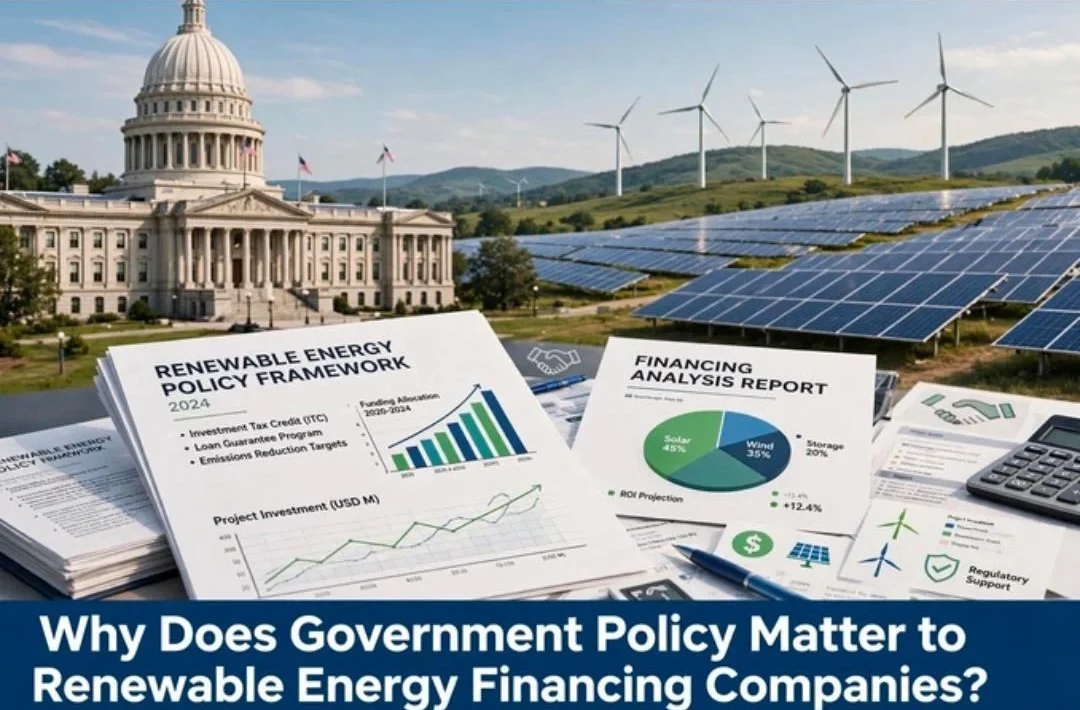
Financing the renewable energy sector is critical to the government’s approach, as financing clean energy projects often requires substantial initial investment and a long-term payback period. Demand for financing can be affected by policies on subsidies, renewable purchase requirements, project approvals, domestic manufacturing and energy goals. These policies have an impact on the volume of projects which approach banks for loan and the industries that need financial assistance for their projects like the IREDA. The relationship between renewables and investments can therefore be understood to evaluate the potential impact of policy changes on renewable energy investment companies in the long term.
Government Policies Can Influence Project Demand
Renewable energy initiatives require a mix of private investment, institutional finance and government backing. Policy options can turn the sustainability of a solar, wind, hydro or other renewable energy project into a positive or negative factor. If governments introduce a scheme or a target that would incentivize more renewable generation, developers might need to invest more in debt to finance the new generation.
For instance, the Ministry of New and Renewable energy has launched a number of programmes in the solar, wind, bioenergy, and other renewable energy technologies. The PM-KUSUM scheme aimed to increase decentralised solar energy and solarisation of agricultural pumps and central financial support for eligible projects.
For investors looking at renewable energy companies, opening a demat account online can provide access to listed securities and make it easier to track companies operating in this sector.
Subsidies Can Affect Financing Requirements
Government financial assistance can also influence the funding structure of renewable energy projects. Subsidies may reduce the amount that project developers need to finance themselves, while also improving the financial viability of certain projects.
The grid-connected rooftop solar programme, for instance, provides central financial assistance to eligible residential consumers, with support transferred after installation and verification under the applicable mechanism.
For financing companies, such programmes can create opportunities to fund projects where government support forms part of the overall project economics. However, the availability, eligibility and duration of such schemes remain important factors when assessing future financing demand.
Renewable Purchase Obligations Support Demand
Regulatory requirements can also influence renewable energy investment. Renewable Purchase Obligations require specified electricity consumers and entities to source a prescribed portion of their electricity requirements from renewable sources.
IREDA’s annual report has highlighted the government’s wind RPO trajectory, under which the obligation for wind power was scheduled to rise from 0.81% of consumption in FY2022-23 to 3.36% in FY2025-26 and 6.94% by FY2029-30.
Such requirements can support demand for new renewable projects because obligated entities need renewable power to meet regulatory requirements. This can indirectly create financing opportunities for companies involved in funding renewable energy infrastructure.
Policy Stability Matters for Long-Term Financing
Renewable energy projects generally have long operating lives, meaning developers and lenders need visibility over the regulatory environment. Changes in tariffs, subsidies, procurement rules or project eligibility can affect projected cash flows.
Government guidelines for competitive bidding in solar, wind, hybrid renewable energy and renewable projects with energy storage provide frameworks for procuring power from these projects.
For a financing company, a predictable policy environment can make it easier to assess project cash flows and credit requirements. Conversely, significant changes in regulations can alter project economics and influence lending decisions.
IREDA’s Role in Renewable Energy Financing
IREDA is a Navratna public sector enterprise under the Ministry of New and Renewable Energy and focuses on promoting and financing renewable energy projects across India. Its financing schemes cover areas including solar, wind, hydro, bioenergy, waste-to-energy, energy efficiency, compressed biogas and emerging technologies.
The company’s role means that government policy is closely connected with its operating environment. When policy encourages additional renewable capacity or introduces new areas of support, financing institutions may see demand from projects in those segments.
IREDA’s FY2025-26 results also showed an expansion in its loan book, along with its highest-ever annual profit after tax of ₹1,873 crore.
How Policy Developments Can Influence Investors
Investors tracking the sector may examine government announcements alongside a company’s financial performance. Changes in renewable energy targets, financing schemes, domestic manufacturing policies, subsidies and procurement rules can provide context for understanding future business opportunities.
When reviewing the IREDA share price, investors should consider the company’s financial results and the broader renewable energy financing environment together. Market prices can change based on earnings, valuations, interest rates, sector sentiment and expectations about future growth. Government policy is one factor among several that may affect how investors assess the company.
Conclusion
Government policy matters to renewable energy financing companies because it can influence project demand, subsidies, regulatory requirements and investment activity across the sector. For IREDA, its role as a specialised renewable energy financier makes policy developments particularly relevant to its business environment. However, policy support should be considered alongside loan growth, asset quality, profitability, funding costs and broader market conditions. Investors can therefore track policy announcements and company disclosures together when assessing developments related to renewable energy financing and the IREDA share price.